
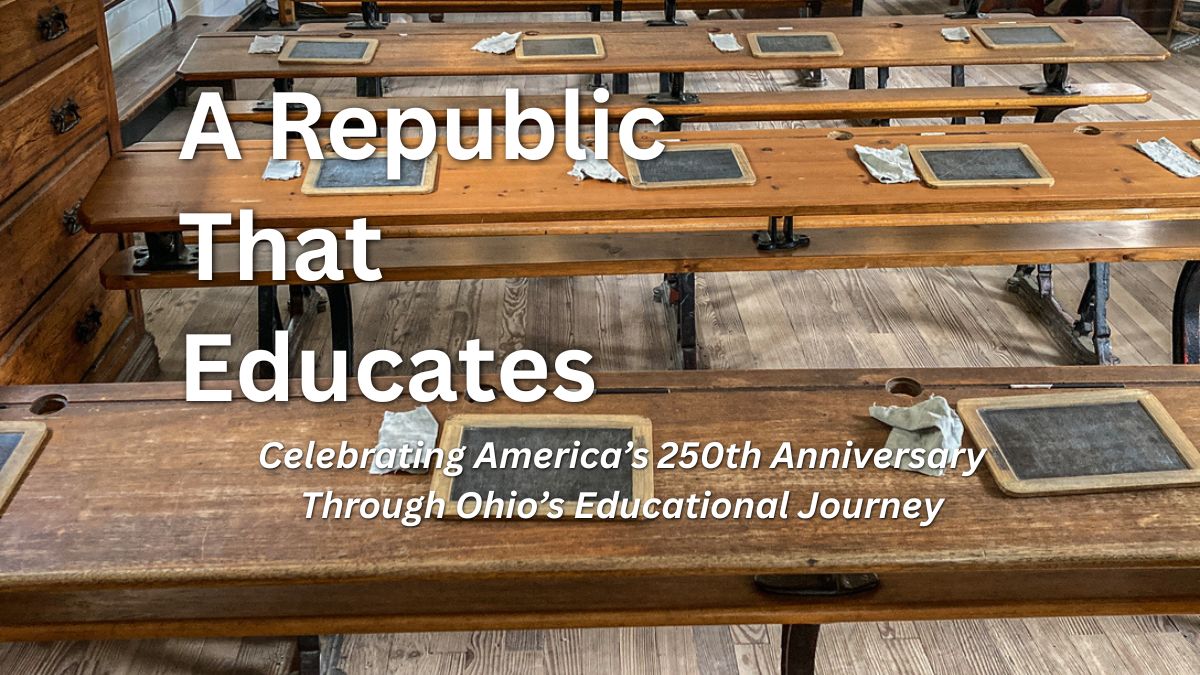
A Republic That Educates: Celebrating America’s 250th Anniversary Through Ohio’s Educational Journey
Beth Lawson – Director of Media & Communication, School Choice OhioBy reflecting on our past, we prepare the next generation for the future.
As the United States approaches its 250th anniversary in 2026, Americans have an opportunity to reflect on the institutions that have sustained our republic since its founding. Among the most important is education. From the earliest frontier schoolhouses to today’s diverse learning environments, education has been central to the American experiment—and few states illustrate that story more clearly than Ohio.
Ohio’s education system did not emerge fully formed. It grew alongside the nation itself, shaped by the belief that an educated citizenry is essential to freedom, self-government, and economic prosperity. As we celebrate America’s Semiquincentennial—the historic milestone marking 250 years since the United States Declaration of Independence—Ohio’s educational journey offers a powerful reminder: education has always been about opportunity, responsibility, and the future of democracy.
Education in the Beginning: Frontier Schools and Community Responsibility
When Ohio became a state in 1803, formal schooling was limited, local, and often temporary. The foundation for education in the territory had been laid earlier by the Northwest Ordinance, which declared that “religion, morality, and knowledge” were necessary for good government and should be encouraged.
In practice, early education looked very different from today. Most children who attended school did so in:
- One-room schoolhouses
- Church-run or community-run classrooms
- Seasonal schools that operated only part of the year
Teachers were often minimally trained, and parents frequently paid tuition directly. Students of all ages learned together in a single room, progressing at their own pace rather than by grade level. Education focused on practical skills needed for daily life and civic participation. The typical curriculum was simple but purposeful:
- Reading (often from the Bible or primers)
- Writing and penmanship
- Arithmetic
- Moral and religious instruction
The goal was not advanced academic specialization. It was to create literate, responsible citizens capable of sustaining a young republic.
Building a System: Ohio Helps Pioneer Public Education
By the mid-1800s, Ohio’s population had grown rapidly, and communities began to recognize that informal schooling was not enough. Educational opportunities varied widely, and many children lacked consistent access to instruction.
A turning point came in 1847 with the passage of the Akron School Law, a reform that helped transform scattered local schools into a coordinated public system. This innovation unified schools under common governance, standardized funding, and introduced graded classrooms organized by age.
Within a few years, the model spread across the state, establishing:
- Publicly funded school districts
- Elected school boards
- Tax-supported education for all children
Ohio became one of the states where the modern American public school system took shape. These reforms reflected a growing belief that education was not simply a private benefit—it was a public necessity essential to democracy.
Why the School Year Looks the Way It Does
Even familiar features of modern schooling, like the academic calendar, reflect Ohio’s history.
In the 1800s:
- Rural schools operated primarily in winter, when farm work slowed
- Urban schools often ran year-round
- School buildings lacked ventilation or cooling in summer
Over time, these patterns merged into a standardized school year of roughly nine months with a summer break. Contrary to popular belief, the calendar was not created solely for farming. It was a practical compromise shaped by agriculture, urban living conditions, and tradition. This blend of local needs and statewide coordination became a hallmark of American education—and a defining feature of Ohio’s system.
The Constitutional Commitment to Education
Ohio’s dedication to education is written directly into its governing document. In 1851, delegates to the state constitutional convention established a clear mandate that still guides education policy today.
Article VI, Section 2 of the Ohio Constitution requires the state to provide: A “thorough and efficient system of common schools throughout the state.” This phrase was carefully chosen and remains one of the most influential education provisions in the country. Delegates to the convention debated fundamental questions:
- Should education be guaranteed statewide?
- How should schools be funded?
- Who should control public education?
- How could the system adapt to future needs?
Their answer was to create a flexible but firm obligation. The state would be responsible for ensuring education existed for every child, while local communities would manage daily operations.
Importantly, the language was intentionally broad. It did not mandate a single type of school, curriculum, or delivery method. Instead, it established a principle: the state must ensure access to education and allow future generations to determine how best to provide it. More than 170 years later, that sentence remains unchanged.
Education and Democracy: The Founders’ Vision
The architects of Ohio’s education system understood that education was inseparable from democracy. They believed:
- Citizens must be informed to vote wisely
- Communities need skilled workers to prosper
- A republic depends on shared civic values
Education was not viewed as charity. It was considered infrastructure—just as essential as roads, courts, or public safety. This philosophy echoed the ideals of national leaders like Thomas Jefferson, who argued that the survival of the republic depended on an educated population capable of self-government.
Ohio’s constitutional language reflected that same conviction: education was a public responsibility that would sustain freedom for generations.
From Uniformity to Opportunity: The Evolution of Educational Choice
As Ohio’s population diversified and the economy changed, families began seeking educational options tailored to their children’s needs. Over time, the state expanded opportunities beyond traditional neighborhood schools. Today, Ohio families can choose among:
- Public district schools
- Charter schools
- Private and faith-based schools
- Specialized programs for students with unique needs
- Scholarship programs supporting educational access
These options represent a natural evolution of the state’s original mission: ensuring that every child can receive an education that prepares them for citizenship and success.
School choice reflects several enduring principles:
Access
Early reformers wanted all children to attend school. Modern choice programs extend that goal by helping families find the right environment for their child.
Local decision-making
From one-room schoolhouses to elected school boards, Ohio has long trusted communities and families to make educational decisions.Adaptation to changing needs Just as the school calendar and currriculum evolved over time, education today continues to adjust to new challenges and opportunities.
Why School Choice Matters to Ohio’s Founding Vision
School choice is often discussed as a modern policy innovation, but its roots reach deep into Ohio’s history. The state’s founders did not prescribe a single educational model. Instead, they established a system designed to evolve with society. Their goal was not uniformity—it was effectiveness.
The phrase “thorough and efficient” was meant to ensure that education would:
- Serve all students
- Produce meaningful results
- Remain flexible as communities changed
School choice supports these objectives by allowing families to select educational settings that meet their children’s needs. In doing so, it strengthens the very system the founders sought to create.
In many ways, school choice represents continuity rather than departure. It reflects the same spirit of innovation that produced Ohio’s early public schools, standardized curriculum, and statewide governance.
A 250-Year Legacy—and the Next Generation
As the nation commemorates 250 years of independence during the United States Semiquincentennial, education stands as one of the most enduring achievements of the American experiment.
From frontier classrooms to modern learning environments, Ohio’s story demonstrates how education has adapted to meet the needs of each generation while preserving core democratic values.
The journey from one-room schoolhouses to today’s diverse educational options tells a powerful story about freedom, responsibility, and opportunity.
And as America enters its next century, that story continues—written each day by students, families, and educators across Ohio.
Because the future of the republic has always depended on the education of its people.
Stay Informed
Sign up for our email list to stay update to date on the latest School Choice news.